The Project
The Project
A central objective of To2DOx is the fabrication of a completely new family of materials, namely, 2D correlated oxides with the aim of stabilizing robust collective 2D states. Apart of the effort in synthesis this will encompass an in-depth study of the defect structure to address the effect of defects on the stability and properties of the 2D collective states. While in conventional graphene-like 2D materials there is weak bonding in the out of plane directions with limited or no dangling bonds, in transition metal oxides the rigid and strongly directional oxygen sub-lattice determine strong bonds in the out of plane direction. Strong surface reconstructions can be anticipated in isolated freestanding layers and probably a completely new defect “zoology” which will come hand-by-hand with wide changes in the electronic properties. As a third objective we will fabricate heterostructures between 2D van der Waals and 2D oxides to explore the possibility of using the transformative effect of proximity effects to modify 2D electronic groundstates. An interesting facet will emerge from the absence of bonding at the interfaces of the stacks made of dissimilar 2D layers. Proximity interactions at the interfaces between correlated oxides are to great extent determined by epitaxial strain, rotations of the oxygen cages and the bonding reconstructions at the atomically perfect interfaces. Finally, we will explore a completely new generation of proximity phenomena between 2D oxides and 2D van derWaals materials. These effects might be exploited to engineer electronic groundstates with tunable responses and functionalities for novel devices.
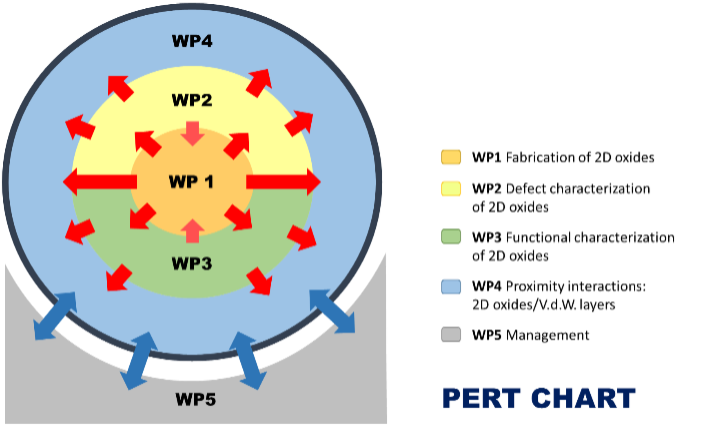
To2Dox is structured in four scientific workpackages (WP). Starting from the fabrication of freestanding 2D oxide layers (WP1), the project will proceed to characterize their defect structure (WP2) and functional properties (WP3). The project aims at combining these layers in functional heterostructures with conventional 2D vdW materials to explore emergent states induced by proximity effects (WP4). The Pert chart highlights the interdependencies of the different WPs.